The Moral, Social and Political Philosophy of the British Idealists by William Sweet
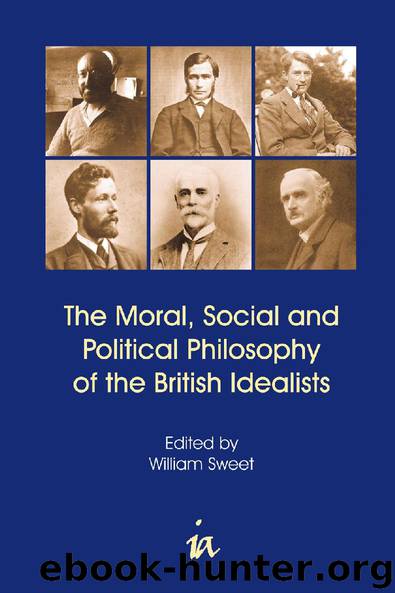
Author:William Sweet
Language: eng
Format: epub
Tags: Idealism, metaphysics, social policy, public policy, moral philosophy, social philosophy, moral education, ethics, Green, Caird, Ritchie, Bradley, Bosanquet, Jones, McTaggart, Pringle Pattison, Webb, Ward, Mackenzie, Hetherington, Muirhead, Collingwood, Oakeshott, self realisation, liberalism, duty
ISBN: 9781845405328
Publisher: Andrews UK Limited 2017
Published: 2017-03-17T00:00:00+00:00
There is a direct argument for this which derives simply from his metaphysical theory of the good and of values in general, and it is this rather than his technical argument that I think was always in the back of his mind. If the good and existence coincide, then, if love is the highest order value, existence is composed of loving states. But McTaggart argues that in such states there is no reason for anything to change.
His technical argument has occupied - and continues to occupy - many pages in books and learned journals, and it continues to have supporters, including Hugh Mellor and Gerald Rochelle. Those who have been puzzled deeply include C.D. Broad, A.C. Ewing, G.J. Whitrow, R.M. Gale, and J.R. Lucas - but also Rochelle and Mellor. [15] But I think, once again, that the argument hides more than it explicates about McTaggart’s central concern.
I will explain the argument briefly and then say why I think this.
McTaggart begins his discussion of time by noticing that we require two temporal series in order to render intelligible our common notions of time. [16] One of these is the series which we designate by the words past, present, and future. The other is the series which we designate by the words earlier and later. McTaggart calls these series, respectively, the A and B series, and it will be convenient to adopt this lettering. The B series is the one which we usually think of as composing history: In it, everything has one and only one fixed place. Julius Caesar crossed the Rubicon earlier than the time at which the Roman Republic became the Roman Empire, but later than the time at which Cicero was born. All of these events were earlier than the birth of Christ but later than the death of Plato.
These positions never change. If event x was ever earlier than y, x is always earlier than y. This series is not, in itself, temporal for, in it, nothing changes. It is simply a serial order within which everything has a fixed place. The A series is the series which seems to contain change: For the events now past were present, and when they were present, they had been future. Every event is, at some time, past, present, and future. Without both series there is no time for, if we have only the B series, nothing happens, and, if we have only the A series, there is no reference point against which we may cope with the changing temporal predicates. (Whenever anything changes, it must change in relation to something which, for that purpose, must be regarded as unchanging through the relation. Thus if I know that time passes, I must be one person who lives - unchanged, in respect of being an observer - through the change. Otherwise, no one notices the change. If steel shrinks when it gets cold, it must do so in relation to some foot-rule which remains constant. Imagine that everything in the world shrank by a factor of one-half and that everything changed uniformly.
Download
This site does not store any files on its server. We only index and link to content provided by other sites. Please contact the content providers to delete copyright contents if any and email us, we'll remove relevant links or contents immediately.
| Anthropology | Archaeology |
| Philosophy | Politics & Government |
| Social Sciences | Sociology |
| Women's Studies |
The remains of the day by Kazuo Ishiguro(8943)
Tools of Titans by Timothy Ferriss(8345)
Giovanni's Room by James Baldwin(7293)
The Black Swan by Nassim Nicholas Taleb(7085)
Inner Engineering: A Yogi's Guide to Joy by Sadhguru(6775)
The Way of Zen by Alan W. Watts(6574)
Asking the Right Questions: A Guide to Critical Thinking by M. Neil Browne & Stuart M. Keeley(5734)
The Power of Now: A Guide to Spiritual Enlightenment by Eckhart Tolle(5719)
The Six Wives Of Henry VIII (WOMEN IN HISTORY) by Fraser Antonia(5482)
Astrophysics for People in a Hurry by Neil DeGrasse Tyson(5168)
Housekeeping by Marilynne Robinson(4418)
12 Rules for Life by Jordan B. Peterson(4291)
Double Down (Diary of a Wimpy Kid Book 11) by Jeff Kinney(4252)
The Ethical Slut by Janet W. Hardy(4232)
Skin in the Game by Nassim Nicholas Taleb(4223)
Ikigai by Héctor García & Francesc Miralles(4212)
The Art of Happiness by The Dalai Lama(4114)
Skin in the Game: Hidden Asymmetries in Daily Life by Nassim Nicholas Taleb(3972)
Walking by Henry David Thoreau(3937)
